Pentatonic Groupings
Why Groupings?
Initially, when learning the pentatonic scale, one tends to play it up and down. Somehow, you have to memorize it, but you quickly get tired of just playing a scale that never sounds like a solo. An easy solution here would be groupings.
Groupings are a good way to start improvising. Since it’s initially difficult to play melodies in an improvisation, one should resort to alternative exercises such as groupings or melodic rhythms.
Groupings with Pentatonic
The ‘normal’ minor pentatonic scale contains 12 notes on the guitar. 2 notes per string * 6 strings = 12 notes.
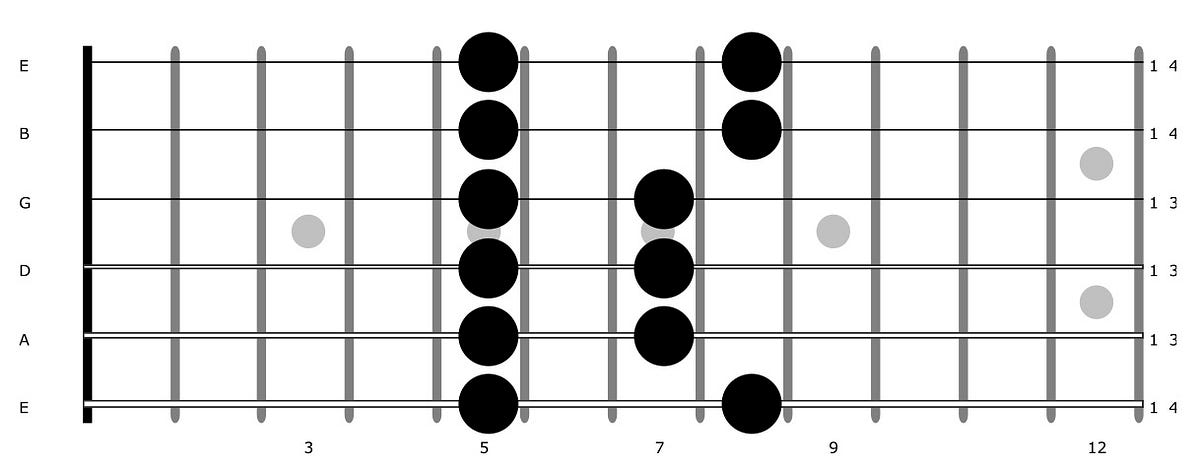
If we play these 12 notes sequentially up and down, it logically sounds just like playing a scale up and down.
However, if we don’t simply play through the entire scale but insert a few pauses, it sheds a whole different light on the pentatonic scale. But where do we insert the pauses?
Below, we see the normal pentatonic scale played up and down (without the double-played note at the end).

Here we have the example of a 2-note grouping.
It’s important here that the pauses should be just as long as the notes themselves. So, if a note has a duration of an eighth note, the pause should also be an eighth note long.

The next example shows a 3-note grouping. So, we play 3 notes consecutively, followed by a pause, then again 3 notes, and so on.

We do the exact same thing with the 4-note grouping.

And finally, the 5-note grouping.
With the 5-note groups, we could also link a 3-note and a 2-note group together and insert the pause after the 2-note group. This way, we would also end up with 5 notes and a pause.

The groupings can also be played consecutively or complementarily. So, a 7-note grouping can be formed with a 4-note and a 3-note group, and so on.
Other Scales
Of course, the groupings can also be used in other scales, such as the seven modes in major or all other patterns of the pentatonic scale.
Different Rhythms
Other rhythms can also be used. A 4-note grouping doesn’t always have to be eighth notes; a 3-note grouping can be played as triplets, and quintuplets can be made from the 5-note grouping.
Grouping is just one of many ideas to break away from the monotony of playing the pentatonic scale up and down.
Example
Here’s an example of an improvisation on the pentatonic scale with various groupings, patterns, melodic rhythms, and note values.