Improvisation on Guitar — Part 1
Musical improvisation is similar to when you’ve made a mistake and then have to fix it -> You become creative! 🙂 However, to be creative, you need a bit of knowledge. For example, you can’t be creative and build a house alone. It requires knowledge of planning, construction, craftsmanship, etc. The same applies to improvisation on the guitar.
What we need for that, though, is much simpler. We simply learn a few scales and then we actually have the knowledge we need.
Pentatonic On Guitar
The number one scale on the guitar is the Pentatonic scale. It’s best to memorize at least one pattern of the Pentatonic scale.
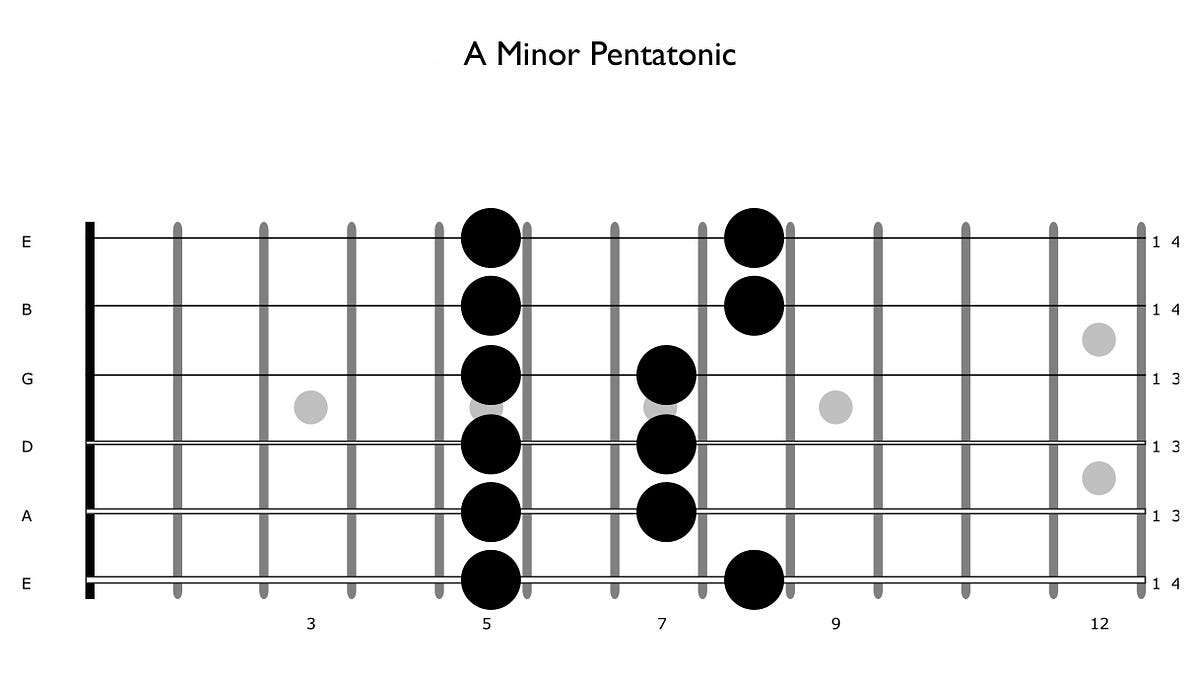
Actually, it would already be possible to improvise over a song or even a static chord now. Let’s try it out:
Try playing the A Minor Pentatonic scale over this static Am chord:
Audio Example (static Am Chord)
Improvisation Example with A Minor Pentatonic
Audio Example (A Minor Pentatonic)
The only thing I played here was the A minor Pentatonic scale, played up and down.
Ionian
To make things a bit more exciting, let’s mix the Pentatonic scale with the Ionian scale. Firstly, this allows us to slide around the fretboard (which looks cool), and secondly, we get some new notes that may sound more interesting than just those Pentatonic notes.
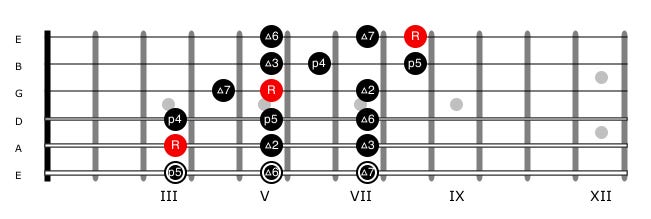
Mixing C Ionian and A Minor Pentatonic
Now, let’s mix both scales together. As a little explanation:
The orange notes are C Ionian starting from the A string.
The orange and magenta notes are C Ionian from the A string and A minor Pentatonic.
The cyan notes are C Ionian starting from the E string.
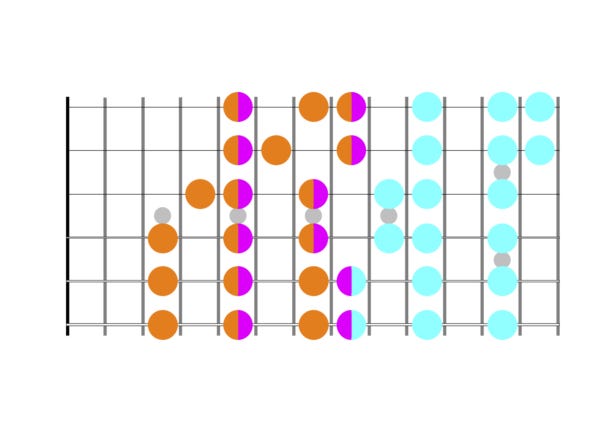
Now we can try starting with the C Ionian on the A string. After a few notes, we switch to the A minor Pentatonic, and then to the C Ionian on the E string.
Audio Example (C Ionian and A minor Pentatonic)
Initially, it will take some time to come up with something good. At first, it might sound like you’re just playing scales up and down. However, gradually, you’ll come up with more and more small fragments and so-called ‘licks’ that you can repeat and that will become part of your own signature style.
Mixing C Lydian and A Minor Pentatonic
Another possibility would be to play C Lydian instead of C Ionian. Before, we always considered Am as the first degree (or 6th degree in major as the parallel key to C major). So how is it possible that we can now simply play Lydian on the first degree, even though Lydian is actually the 4th degree? Quite simply, it’s no longer the first degree. We are now in the key of G major, not C major. Accordingly, C major is the 4th degree, which is Lydian, and A minor is the 2nd degree, which is Dorian.
Please note that this is a simple explanation. One could interpret and explain it in a much more elaborate way. I just tried to describe it as simply as possible.
With Dorian, you can still stick to the pentatonic scale; the notes played in the Dorian scale match the pentatonic scale. Now we have a completely different sound:
Audio Example (Lydian with A minor Pentatonic)
Now, try to expand on these ideas. Play around a lot with these different scales. Try to blend them together and get used to the sound.