What is the difference between major and minor?
As we already know, (or not know) the difference between major and minor is the interval called “third” in a chord.
So, if we have, in addition to a root note and a fifth, a major third, the chord is major. If we have a minor third, the chord is minor.
On the guitar, it’s quite easy to transform a major chord into a minor chord.
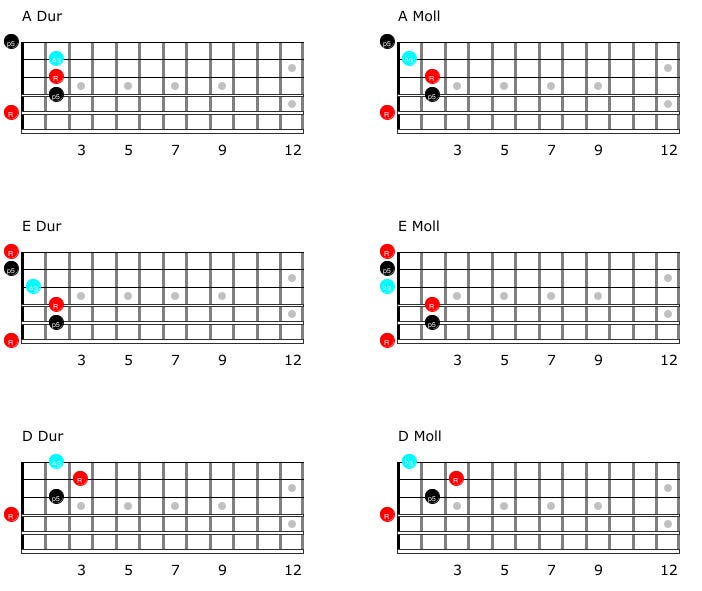
Example with chords with open/empty strings:
The note in cyan represents the third and is shifted by one fret.
(Dur is Major while Moll is minor)
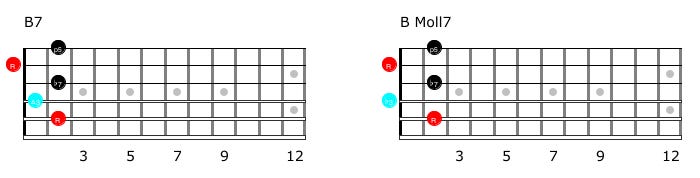
Even with dominant 7th chords, there is a third that can be shifted. This transforms a B7 into a Bm7:
To change the third in a barre chord, you can proceed as follows:
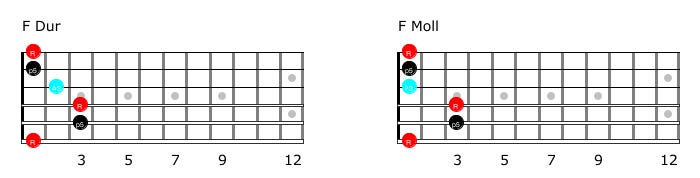
Normally, when nothing is specified, for example, just ‘D,’ it means ‘D major.’ However, if it says ‘Dm,’ it means ‘D minor.’
Long story short; minor sounds sad, while major sounds happier. Here’s a simple example of major and minor, play:
Doesn’t sound very logical or exciting: || D | C | Bb :||
Now I replaced just one single chord with a minor chord (D major with D minor swapped): || Dm | C | Bb :|| sounds much sadder.
As the next option, you could, for example, complement the chords a bit with different bass notes: || Dm | C/F | Bb/D :||
Or even always keep the same bass note: || Dm/F | C/F | Bb/F :||
You can find a PDF with the above examples played on guitar here: