MelodyChords / ChordMelody / Fingerstyle
Whoever can play the guitar knows this all too well; you’re somewhere far from home, with only the foxes and hares saying goodnight, and suddenly someone thrusts a guitar into your hands, almost forcing you to play.
Either you play the chords of any song that comes to mind and sing along, or even worse, you just play its melody! :P
You can save yourself if you can sing, or if someone in the group can sing and support you. But what if none of them can sing?
The solution is: Melody Chords, also known as Chord Melody or Fingerstyle.
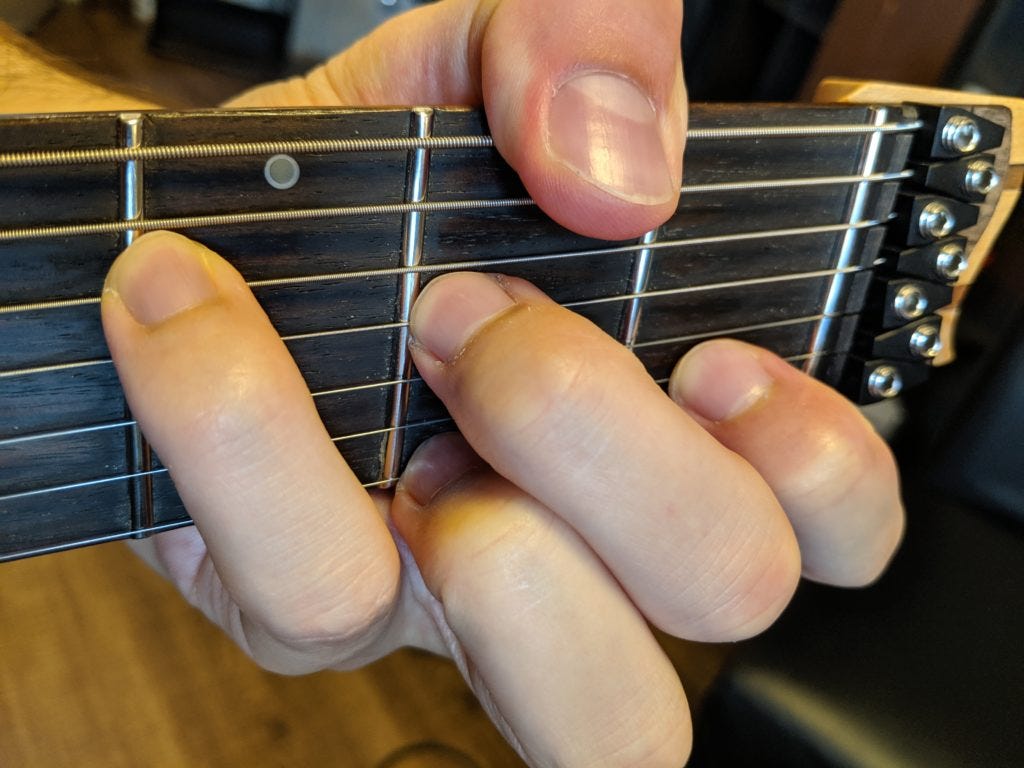
It’s the perfect trick for a one-man show, and everyone automatically thinks you’re a guitar superstar.
My Heart Will Go On
The melody is probably known by everyone!

The chords for it are: || D | A | G | D A ||
Let’s assume nobody can sing, and I play either chords or melody alone, it remains quite empty. However, if I play both together, it becomes a bit more lively.
Shallow
The exact same thing with Lady Gaga’s “Shallow.” Either you play/sing the melody or the chords. But what if I want to do both at the same time?

How does it work?
The first important rule is:
- The note of the melody is always more important than the chord.
Our ear automatically perceives the highest note as the melody. So, in general, we ignore all notes that are higher than the melody note.
If a melody note is not in a chord, it must be added.
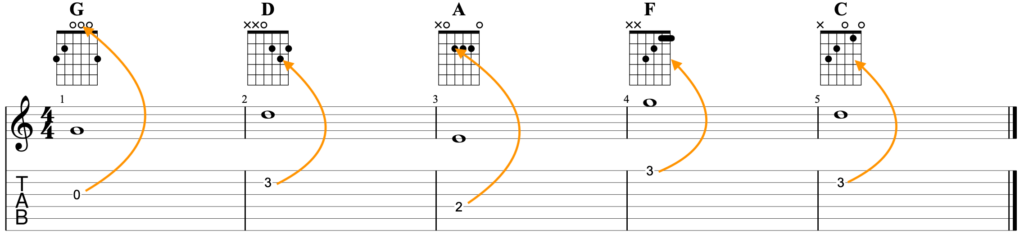
In the first measure, we see the chord ‘G’ with the melody note ‘G’. Here, the chord can be played up to and including the third lowest string (so a total of 4 strings). The lowest two strings cannot be played because they are higher than the melody note.
The same applies to the chord D. Here, the highest string should not be played because the melody note is on the second highest string.
It also sometimes happens that the melody note is very close to the lowest string. For example, with the ‘A’ chord, only 2 strings can be played in total. The melody note is on the D string (meaning the G, B, and high E strings cannot be played because they are higher than the melody note, and the low E string cannot be played because it is not part of the A chord).
Take the ‘F’ chord as another example. Here, the melody note is not already included in the chord. This means we add it “artificially,” preferably with the pinky finger. However, the rest of the chord should be left as is, as otherwise, the chord won’t sound complete.
The same applies to the ‘C’ chord example. Grip the C chord, use the pinky finger to play the melody note, and do not play the lowest string (as it is higher than the melody note).
In principle, this can be done with any song, no matter how difficult. It’s also not necessary to play the melody exactly as the singer sings it every time. You can make your own interpretation, and it will still be recognized.
(If you play the melody of “Happy Birthday” when you want to play “Yellow Submarine,” of course, it won’t be recognized as “Happy Birthday.” The melody is indeed crucial, but you can easily omit a few notes or add a few extras.)
Learning and Application
The easiest way to quickly learn Melody Chords is to practice this technique a lot.
Choose simple pop songs for this purpose. Get the sheet music and chords (it’s best to transcribe both yourself) and just start practicing.
Play one chord per measure on the first beat.
Then try to play the melody, but keep the chord being played simultaneously. Otherwise, it will be cut off too quickly.
Pay close attention to which note is the melody note and do not play any note higher than the melody note itself.